
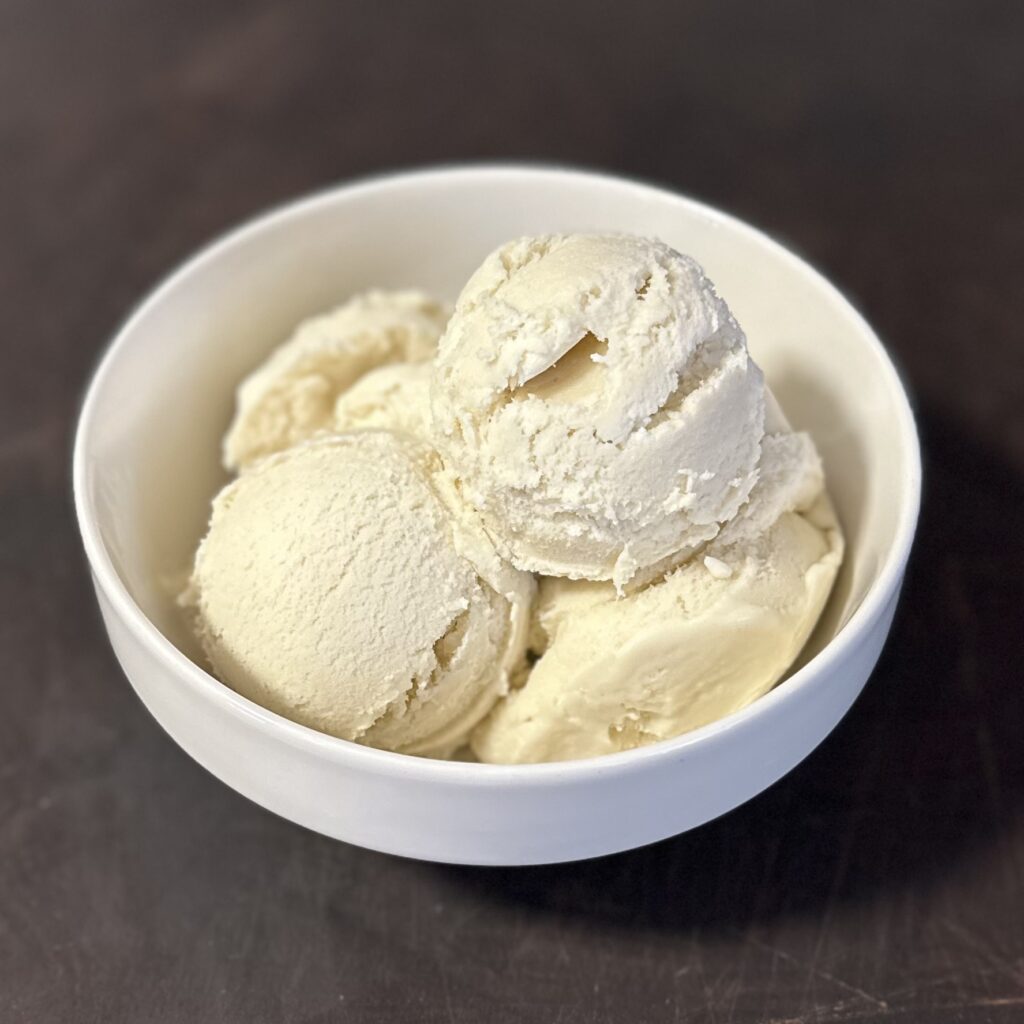
This one has been a family relay race.
My mom picked up the original from somewhere I have never managed to trace, and if I ever find it I will credit it properly. She changed it to use egg whites, for the protein. I changed it again, because I am not willing to throw away yolks. The yolk is where the choline is, and the fat-soluble vitamins, and most of what makes an egg worth eating. It also turns out that whole eggs give you the same soft scoop that made her version worth copying, so there was nothing to trade off in the end.
The sweetener is allulose, which is the reason this works at all. Most low-carb sweeteners freeze into a brick. Allulose does not, and it is one of the few that does not leave me regretting it an hour later.
What is in it, and why
- Whole eggs. This is a custard base, so the eggs are doing structural work as well as nutritional. Yolk lecithin is an emulsifier, which is what keeps the fat and water from separating into ice crystals as it freezes. Egg whites alone will set harder, which is worth knowing if you decide to go that way.
- Allulose. A rare sugar, found in small amounts in figs and raisins. It tastes close to sugar, and it lowers the freezing point of the mixture the way sugar does, which is the whole reason the texture holds. Erythritol and most sugar alcohols do not do this, and that is why they give you a scoop you can chip a spoon on.
- Your base, coconut or A2. Fat is what carries flavor and stops the mixture freezing hard. Coconut cream and coconut milk together give you a softer set and a slight coconut note. A2 dairy gives you the more classic custard. A2 refers to the beta-casein protein: some people who do badly on ordinary milk do fine on it, and some do not, and it is worth testing rather than assuming.
- Salt. A quarter teaspoon in a sweet base does not read as salty. It sharpens the vanilla and takes the flat edge off allulose, which can taste slightly hollow on its own.
- Vanilla, and cocoa if you are going that way. Add the vanilla off the heat. Volatile aromatics leave with the steam if you add them while the pan is hot, and you lose most of what you paid for.
If you want it to be a genuinely high-protein bowl
Worth being straight about this, as the recipe has carried the word protein for years and it deserves to be earned rather than assumed.
Swapping whole eggs for five whites, which was my mom’s change, does not add much protein in absolute terms. Five whites and three whole eggs land in roughly the same place. What the whites do is take out the fat, so the protein makes up a larger share of what you are eating. Her instinct was sound, and it was about density rather than quantity.
If you want the number to actually move, add protein powder to the base. I use The Myers Way Paleo Protein, which is collagen-based rather than whey or pea. Two things make it work here where most powders do not: collagen dissolves into a warm liquid without going chalky, and there is no dairy protein in it to fight with a coconut base. Two scoops roughly doubles the protein in the batch. Check your own label, as scoop sizes vary a good deal between brands.
Two things to expect. The flavored versions are already sweetened, so cut the allulose by about a third or you will overshoot. And protein powder firms the set, so a batch with it in wants a little longer on the counter before you try to scoop it.
Powder the allulose first
If yours is granulated, run it through a blender or a food processor before it goes anywhere near the pan. Granulated allulose dissolves reluctantly and what does not dissolve turns gritty in the freezer. Thirty seconds of blending is the difference between smooth and sandy, and it is the step people skip.
Check the label before you buy allulose
Allulose is increasingly sold cut with dextrose, and dextrose is glucose. If the reason you are reaching for allulose is that ordinary sugar does not work for you, a blend defeats the point, and the front of the bag will still say allulose in large letters. Turn it over and read the ingredient list. You want one ingredient.
This has moved recently enough that a supplier who was fine last year may not be now, mine included. As of this update, Vitacost and Azure Standard both carry a single-ingredient allulose. My mom and I went in together on a fifty pound bag from Azure, which sounds unhinged until you price it per pound against the little pouches. It keeps indefinitely in a sealed bucket.
A note on allulose and GLP-1
Allulose comes up a lot at the moment because of GLP-1, the hormone involved in appetite signaling and blood sugar regulation. Some small human studies have found that allulose modestly stimulates GLP-1 release, and others have found lower glucose and insulin responses after a meal when allulose is eaten alongside carbohydrate.
That is interesting, and it is not the same thing as a medication. The studies are small, the effect is modest, and nobody should read a bowl of ice cream as a metabolic intervention. What it does mean is that allulose behaves differently in the body from ordinary sugar, and for some people that difference is the reason a dessert is possible at all. That is enough of a reason on its own.
One practical thing worth knowing: allulose is not absorbed the way sugar is, and in larger amounts it can cause the same bloating and looseness that any poorly absorbed sugar does. Tolerance varies a great deal between people. If it is new to you, have a small bowl the first time and find out where your own line is before you serve it to guests.
The kit
A churn makes a real difference here, and a basic freezer-bowl machine is enough. Mine is on my kitchen list along with the thermometer, which matters more than the machine does. Without a churn you can still freeze it in a shallow dish and stir every twenty minutes until it sets, and it is genuinely fine, just denser.
Some of these links earn me a small commission. It does not change what you pay, and I only list things I actually use.
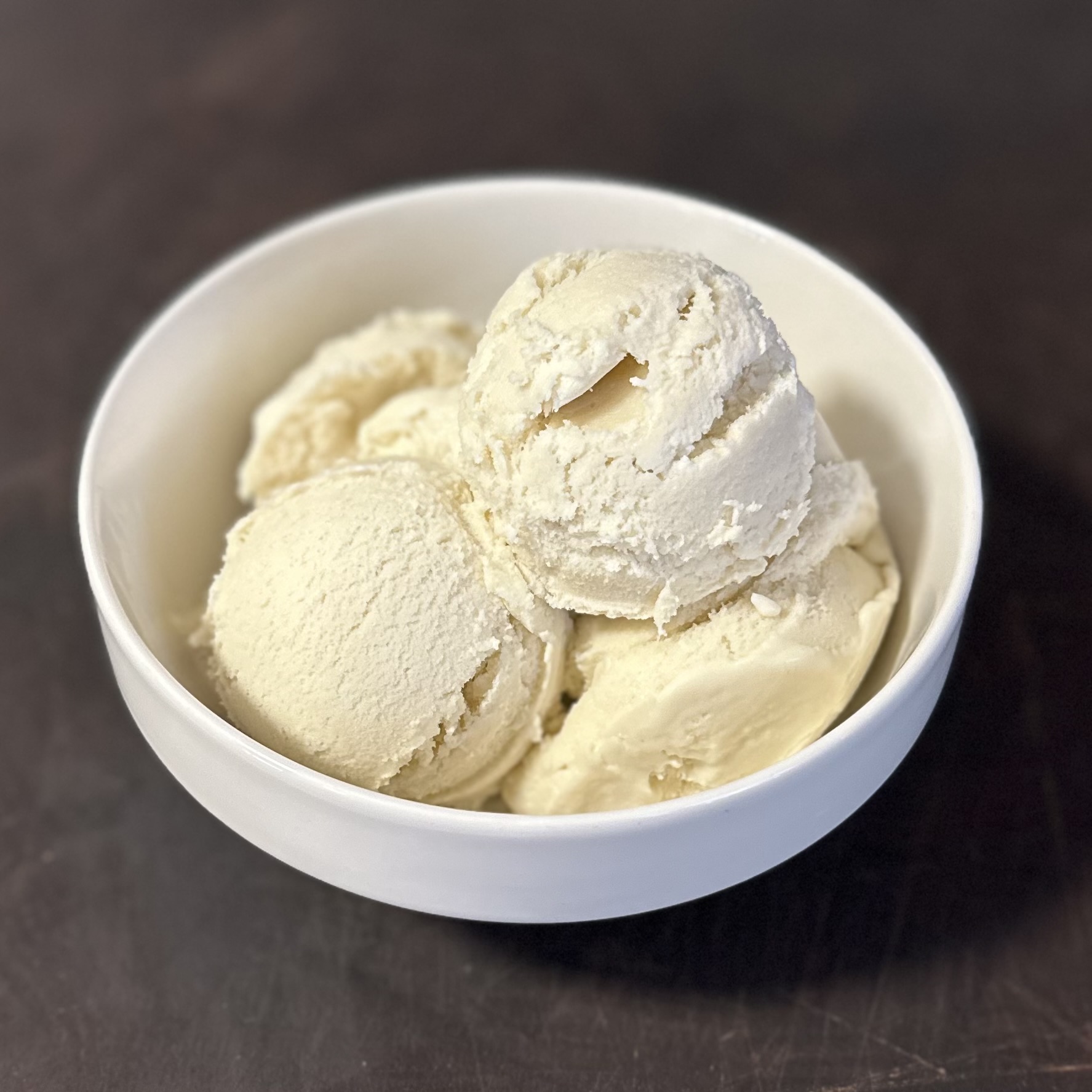
Allulose Custard Ice Cream
A whole-egg custard base sweetened with allulose, which is what keeps it soft enough to scoop straight from the freezer. Coconut or A2 dairy, vanilla or chocolate, with a collagen option that makes it a real protein dessert.
Conversions are approximate. Whole foods vary.
Glycemic regulation — allulose is largely not metabolized as sugar, and the fat and egg alongside it slow everything further. A dessert that does not put you on the floor an hour later.
Nutrition — three whole eggs in the batch, so the yolks come along with the choline and the fat-soluble vitamins rather than going in the bin.
The base needs to reach 170–175°F, which is 77–79°C. That is hot enough to make the eggs safe and thicken the custard, and cool enough that it does not scramble. Use a thermometer rather than guessing, and temper by drizzling the hot liquid into the eggs while whisking, never the other way around.
Start with a small bowl if allulose is new to you. It is poorly absorbed, and in quantity it can cause bloating and looseness. Tolerance varies a lot between people.
Ingredients
The base, choose one
- 2 cup coconut cream and coconut milk, about half of each
- 2 cup A2 half-and-half
- 2 cup A2 heavy cream and A2 whole milk, about half of each
Everything else
- 3 whole eggs, or 5 egg whites
- 0.5 cup allulose, powdered
- 1 tsp vanilla extract
- 0.25 tsp salt
For the higher-protein version
- 2 scoops collagen-based paleo protein, unflavored or matched to your flavor
- Cut the allulose by about a third if your protein is a sweetened flavor
For the chocolate version
- 0.5 cup cocoa powder
- 4 oz dark or sugar-free chocolate, chopped, optional
Method
- Blend the allulose to a powder if it is granulated. Thirty seconds is plenty.
- Warm your chosen base in a saucepan to 170–175°F, which is 77–79°C. Whisk the powdered allulose in until it has fully dissolved.
- Whisk the eggs in a separate bowl until they are smooth and even.
- Temper: drizzle the hot base into the eggs slowly, whisking the whole time. Slowly is the whole instruction here.
- Return the mixture to the pan over low heat and whisk until it thickens enough to coat the back of a spoon.
- Whisk in the cocoa now if you are making the chocolate version, and stir the chopped chocolate through until it melts.
- Take the pan off the heat and stir in the vanilla and salt.
- If you are adding protein powder, whisk it in now, once the pan is off the heat. Add it a scoop at a time and whisk each one through before the next. An immersion blender for ten seconds settles any lumps that survive.
- Cool 2 hours, or overnight. Do not shorten this. Warm base going into a churn gives you soup.
- Churn about 20 minutes. Without a machine, freeze in a shallow dish and stir every 20 minutes until it sets.
Notes and swaps
Coconut sets softer than A2 dairy. If you want the more classic custard mouthfeel, go with the cream and whole milk.
Egg whites in place of whole eggs works, five of them. It sets harder and cuts the fat rather than adding protein.
Straining the custard through a sieve before it chills catches any bit of egg that did set, and takes ten seconds.
A batch with protein powder in it needs a few extra minutes on the counter before it will scoop.
It firms up in the freezer overnight. Ten minutes out brings it back.
A shallow container freezes and thaws more evenly than a deep one.
Cost
Coconut version — $8 to $12 a batch.
A2 dairy version — $9 to $14 a batch.
Varies with brand and with how you buy your eggs, and the protein powder adds to it. Allulose is most of the base cost, and it is much cheaper by the bag than by the pouch.
Brenna May Wellness
Where I get these
The Myers Way Paleo Protein and the cocoa are both in my dispensary. I buy protein powder there as well as supplements rather than from a marketplace on principle: the seller can change between orders, and a protein powder is exactly the kind of thing where you want to know the tub came from the manufacturer. The allulose I buy elsewhere now, for the labelling reason above.
The rest of the pantry is there too, along with the household cleaning and skincare I actually use. Browse the whole dispensary.
Some of these links earn me a small commission. It does not change what you pay, and I only list things I actually use.