
My favorite cookie growing up was one my mom made on a whim and then spent years refining because I liked it so much. Double dark chocolate, mint, and nowhere near enough espresso for my taste, which I fixed later by putting in about four times as much.
I made a healthier version for years with sucanat and einkorn, and it used to disappear inside ten minutes at gatherings. Then grains stopped working for me and sugar, which had always been difficult, reached the point where there was no wiggle room left. I gave up on replacing that cookie for a while. It seemed like the kind of thing that does not survive being rebuilt from different parts.
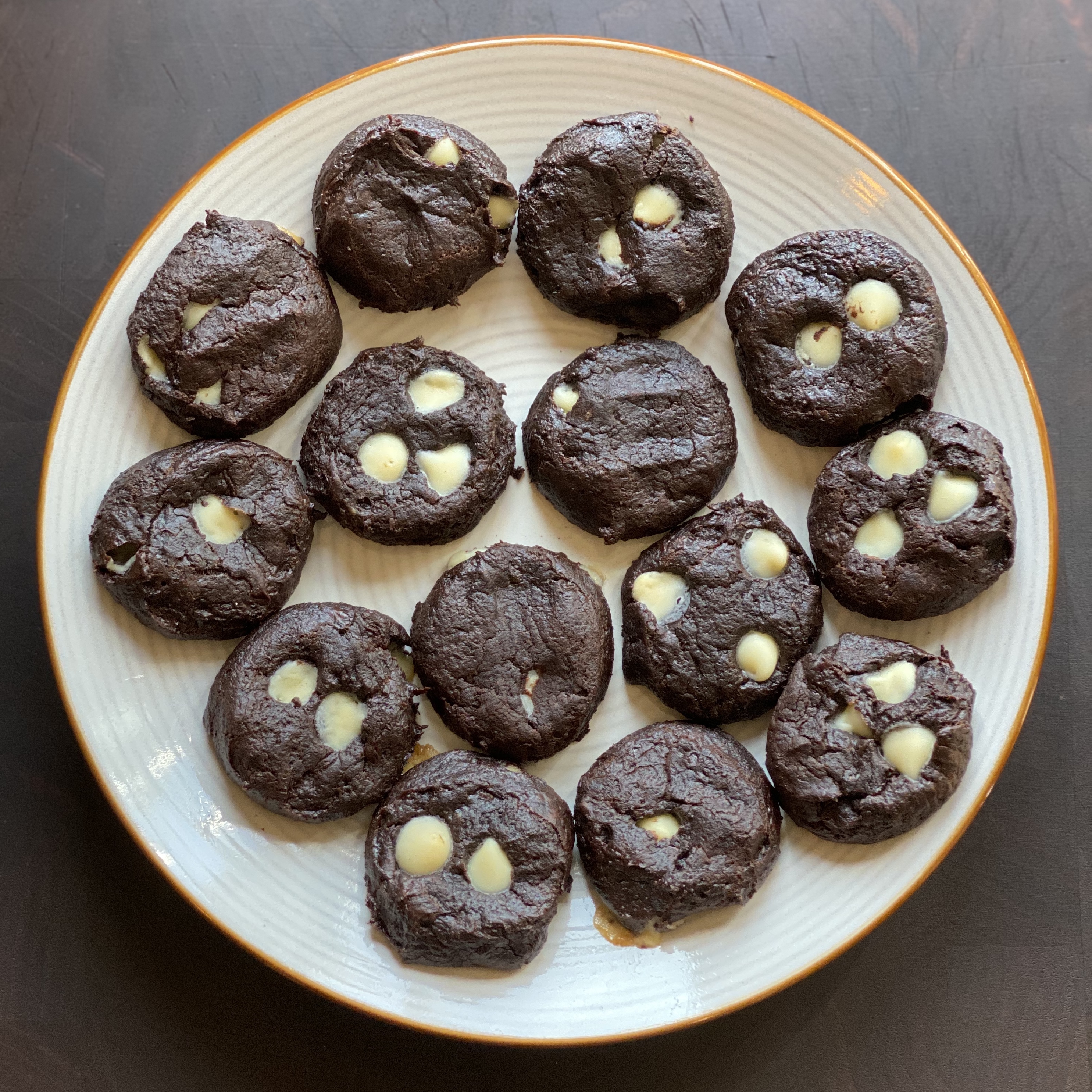
What eventually worked was going the other direction and using what I actually had. Cacao instead of flour, collagen for the chew, and the konjac egg I had already worked out for my other cookies. This is that cookie. It took about three years.
There is no flour in this at all
Three quarters of a cup of raw cacao is doing the job flour does in the base recipe, and the collagen is doing the rest. That is worth knowing if you are used to adjusting a cookie by adding flour when the dough looks wrong, because there is nothing here to add. If a batch comes out too loose, another scoop of collagen or a tablespoon of arrowroot will tighten it.
The dough is wetter than you would expect a cookie dough to be. That is correct and it is where the chew comes from. It also means these will not spread and will not roll by hand, so use a scoop and flatten each one with an oiled palm.
If you want them sweeter, do not add more monk fruit
Cacao needs more sweetening than a plain dough does, so this is the version where people are most tempted to keep adding. Two teaspoons of monk fruit is about the ceiling. Past that most brands develop a faintly cooling bitterness at the back of the mouth, and against three quarters of a cup of raw cacao that reads as harsh rather than sweet.
- Maple sugar, 2 to 4 tablespoons. Dry, so nothing else changes. What I use when these are going somewhere other than my own kitchen.
- Allulose, 2 to 4 tablespoons. Powder it first if granulated. Keeps them soft and browns fast, so pull them early.
- Maple syrup or honey, 2 to 3 tablespoons. Liquid, so take the same amount back out of the konjac water. Honey is not vegan, and honey baked at 325°F is no longer raw, so use the ordinary jar.
Eggs work too
Three eggs in place of the three konjac eggs, with nothing else changed. You get a lighter cookie and a little more protein. The konjac version is denser and fudgier, which suits the cacao, and it costs a few cents against what three eggs cost now.
The chips I actually use
Three brands, sweetened three different ways. Against this much raw cacao the chips are carrying most of the sweetness in the finished cookie, so the bag matters here more than it does anywhere else.
- Just Date. Date sweetened, so real sugar, and the roundest flavor of the three against dark cacao. Worth knowing if you are watching blood sugar closely.
- Goalz. Allulose sweetened, so barely any carbohydrate. Their white chips and their seasonal butterscotch and peppermint are what the low-temperature bake below is for, and the peppermint against espresso and cacao is the best version of this cookie I make.
- ChocZero. Monk fruit sweetened, nothing on the sugar side.
Your chips set the oven temperature
This matters more here than anywhere else, as this cookie is at its best with the pale chips and those are the fragile ones. The batter is happy at 325°F. The chips are not.
- Dark and mint chips — 325°F for 8 to 10 minutes.
- White chocolate chips — 270°F for 10 to 12 minutes.
- Butterscotch and caramel chips — 225°F for 10 minutes.
The low-temperature versions never bake hard, so leave them ten minutes on the tray before you move them.
Three versions
- Espresso. One to two tablespoons of finely ground espresso. I use an organic Swiss Water decaf so I can eat them in the evening. Two tablespoons is assertive and that is the point.
- Espresso mint. The espresso, plus half a teaspoon of peppermint extract. Mint chips instead of dark ones if you can find them. If you would rather use peppermint essential oil, use one sold for food use and start with one drop, as it is far stronger than extract and two drops too many will take the whole batch out.
- Chaga. Two tablespoons of finely ground chaga in with the dry ingredients. It brings an earthy, faintly vanilla note that sits well against the cacao, and it is the one I make when I want the cookie to taste like something other than dessert.
On chaga, worth saying plainly: it is a traditional food and tea mushroom with a long history of use, and the human research behind the bigger claims made for it is thin. I use it because I like the flavor. It is also high in oxalates, and there are case reports of kidney trouble in people taking large amounts daily over long periods. Two tablespoons across a batch of cookies is not that, but if you have a history of kidney stones it is worth knowing before you make it a habit.
Dark Chocolate Espresso Tahini Cookies
Flourless and grain-free, built on raw cacao and collagen rather than any flour. Espresso, mint or chaga, and egg-free with a konjac egg.
Conversions are approximate. Whole foods vary.
Nutrition — three quarters of a cup of raw cacao across a batch, alongside tahini and collagen. The mineral load here is unusual for something shaped like a cookie.
Blood sugar — no sugar and no flour, so what is left is fat, protein and cacao.
Let the konjac gel a full two minutes. Rushed, it stays grainy and the dough will not hold.
Taste the dough before it goes in. Monk fruit strength varies enormously between brands, and cacao needs more sweetening than a plain dough does.
Set the oven by your chips. Butterscotch and caramel need 225°F, white chocolate needs 270°F, dark and mint take 325°F.
These do not spread. Scoop, then flatten each one with an oiled palm.
Ingredients
The binder, choose one
- 1.5 tsp konjac root powder, in 0.5 to 0.75 cup water
- 3 pastured eggs
The chew, choose one
- 6 scoops collagen peptides, about 0.75 cup
- 3 tbsp gelatinized maca powder, for the vegan version
Everything else
- 0.75 cup tahini, well stirred
- 0.75 cup raw cacao powder
- 1.5 tsp monk fruit extract powder, 1 to 2 depending on brand
- 1 tsp vanilla extract
- 0.75 tsp baking soda
- 0.75 tsp pink salt
- 0.5 cup baking chips, see the brands above
Then pick one
- 2 tbsp finely ground espresso
- Espresso as above, plus 0.5 tsp peppermint extract
- 2 tbsp finely ground chaga
Method
- Heat the oven to the temperature your chips need, and line a baking sheet with parchment.
- Put half a cup of water in a medium bowl and sprinkle the konjac powder over the surface. Whisk, and leave it two full minutes to gel. Use the full three quarters of a cup if your tahini is stiff. If you are using eggs, whisk them and carry on.
- Add the tahini and mix until smooth.
- Mix in the monk fruit, baking soda, salt and vanilla, along with whichever of the espresso, peppermint or chaga you are using.
- Add the cacao and the collagen or maca, and mix to a thick, wet dough.
- Fold the baking chips through.
- Scoop onto the parchment. Oil your palms lightly and press each one flat.
- Bake 8 to 12 minutes, according to the chip guide above and the size of your scoop.
- Cool ten minutes on the tray before moving them. The low-temperature versions need this.
Minerals
Magnesium — high. Three quarters of a cup of raw cacao across the batch, and cacao is one of the better food sources there is.
Copper — high. Cacao and tahini together.
Iron — moderate, and non-heme. Mostly the cacao.
Calcium — notable for a cookie. Sesame.
Protein — high for a cookie. Collagen and tahini, with no flour diluting it.
Qualitative, read off the ingredients rather than computed, as the baking chips move the figures considerably between versions.
Notes and swaps
Sunflower seed butter or a mild nut butter works in place of the tahini and changes the cookie less than you would think.
Monk fruit runs from 7 to 50 percent mogroside V between brands, a sevenfold spread, and few labels say which. Start at 1 tsp with a concentrated extract, 1.5 to 2 with a milder organic one, and 2 if you are feeding people who eat ordinary sugar. Taste the dough: with the konjac egg there is no raw egg in it.
A large scoop makes cookies big enough for ice cream sandwiches, which is what my kids ask for.
Add another scoop of collagen or a tablespoon of arrowroot if a batch comes out too loose.
Decaf espresso means you can eat them in the evening without consequences.
These freeze well scooped and raw on a tray.
Brenna May Wellness
The other cookies built on this
- Tahini Chocolate Chip Cookies, the base recipe, with the flour and binder substitution tables.
- Tigernut Tahini Chocolate Chip Cookies, the version that spreads on its own.
Where I get these
The collagen, the tahini, the raw cacao and the konjac powder are all in my dispensary. Konjac is worth buying somewhere you trust in particular, as it is sold in a range of grinds and only the fine one gels properly.
The rest of the pantry is there too, along with the household cleaning and skincare I actually use. Browse the whole dispensary.
Some of these links earn me a small commission. It does not change what you pay, and I only list things I actually use.