
I am often asked for my sourdough starter.
Over the years I’ve started and maintained several versions — in Scotland, the United States, Ireland, and back again — adapting to different grains, sensitivities, and seasons of life.
My first starters were in Scotland, where the flour quality made the process almost effortless. I did learn one important lesson early on: don’t store sourdough in plastic and then leave the country. Fermentation is active. It interacts with its container. That experience pushed me toward glass for nearly everything in my kitchen.
When we moved to the United States, I struggled with conventional wheat. I found I could tolerate flour abroad but not at home — a pattern that became clearer over years of travel. I began using Italian 00 flour and later Einkorn. Both made beautiful starters.
After my Hashimoto’s diagnosis, I stepped away from grain-based sourdough for a time and began experimenting with alternatives — almond, coconut, and eventually cassava. Cassava behaves differently, but the principle remains the same: flour, water, time, and a living culture.
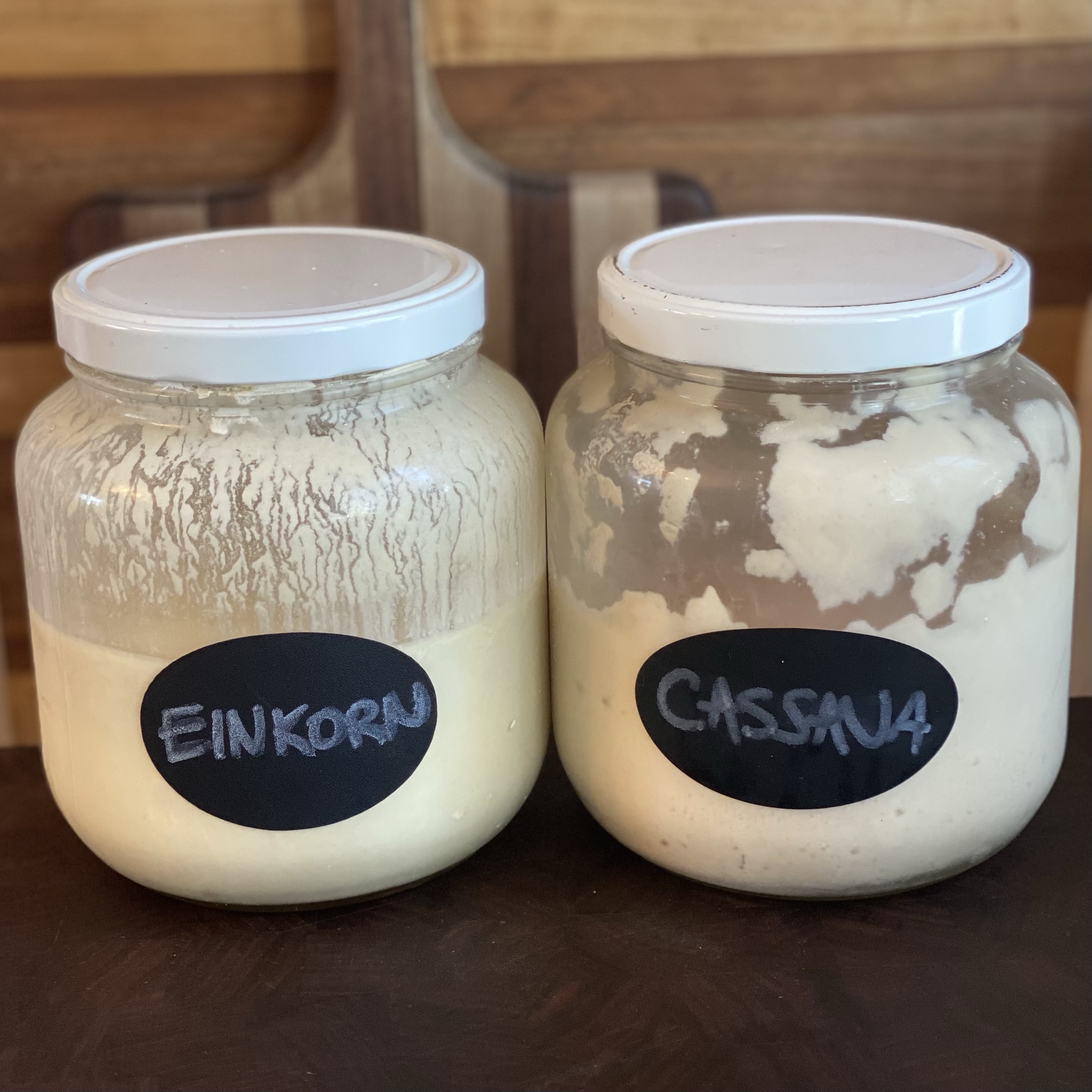
This post covers how I start and maintain three variations: Italian 00, Einkorn, and Cassava. The method is similar. The proportions and sensitivity vary.
The Core Principle
All sourdough starters require flour, non-chlorinated water, and time to ferment.
Grain-based starters (except Einkorn) can benefit from a small amount of yeast to get them going. Einkorn tends to start well without added yeast.
Your water matters more than most people realise. Chlorinated water can inhibit fermentation. Use filtered, well, or properly sourced water.
And always use glass. Starters swell dramatically in the first few days.
Grain-Based Starter (Italian 00 or Similar Wheat)
Day 1
- 1/2 cup warm (not hot) non-chlorinated water
- 1 tsp dry active yeast
- 1/2 cup flour
Let the yeast sit in the water for 10 minutes before adding flour. Stir. Cover loosely.
Days 2–5
Feed daily with equal parts flour and water (1/2 cup each).
After 3–5 days, when it is bubbly and active, it is ready to use or refrigerate.
Einkorn Starter (No Added Yeast)
Einkorn behaves differently.
Day 1
- 1/2 cup warm non-chlorinated water
- 1/2 cup Einkorn flour
Stir and cover loosely.
Days 2–5
Feed daily with equal parts flour and water.
Important: After feeding, leave it at room temperature for 18–24 hours before refrigerating. Einkorn needs that balance period. Refrigerating immediately weakens it. Leaving it out too long can invite Kahm yeast or mold.
If you see grey hooch on top, pour it off, feed, and continue. It is not ruined.
Cassava Starter
Cassava is the most temperamental of the three. Different brands absorb water differently. I prefer Otto’s for consistency.
Day 1
- 1 cup warm non-chlorinated water
- 1 tsp dry active yeast
- 2/3 to 3/4 cup cassava flour (added slowly)
You are aiming for thick pancake batter consistency.
Days 2–3
Feed daily using the same proportions, adjusting based on texture.
Days 4–5
Allow it to sit and strengthen before refrigerating.
Notes
A note on containers
Starters expand significantly in the first few days. Use a large glass jar with room to rise.
A note on water
Make sure your water is non-chlorinated and filtered (or well water). Chlorine can inhibit fermentation.
A note on maintenance
- Refrigerated starters should be fed weekly.
- If dark hooch (liquid) forms on top, pour it off and refresh.
- If you see mold (fuzzy, coloured growth), discard.
Sourdough Starter (Italian 00, Einkorn, or Cassava)
Ingredients
- Non-chlorinated water: filtered, well, or properly sourced
- Flour option A (Italian 00 / wheat): 1/2 cup to start + extra for daily feeds
- Flour option B (Einkorn): 1/2 cup to start + extra for daily feeds
- Flour option C (Cassava): 2/3–3/4 cup to start + extra for daily feeds
- Yeast (only for Italian 00 / cassava): 1 tsp dry active yeast
Instructions
- Choose your flour: Italian 00 (or wheat), Einkorn, or Cassava. Use a large glass jar with room to rise.
- Italian 00 / wheat starter — Day 1: Mix 1/2 cup warm (not hot) water + 1 tsp dry active yeast. Rest 10 minutes. Stir in 1/2 cup flour. Cover loosely.
- Italian 00 / wheat — Days 2–5: Feed daily with 1/2 cup flour + 1/2 cup water. Starter is ready when bubbly and active (usually day 3–5).
- Einkorn starter — Day 1: Mix 1/2 cup warm water + 1/2 cup Einkorn flour. Cover loosely.
- Einkorn — Days 2–5: Feed daily with equal parts flour and water. After feeding, leave at room temperature 18–24 hours before refrigerating.
- Cassava starter — Day 1: Mix 1 cup warm water + 1 tsp yeast. Rest 10 minutes. Slowly add 2/3–3/4 cup cassava flour until it resembles thick pancake batter.
- Cassava — Days 2–3: Repeat the same proportions (adjusting to texture). Let ferment 24 hours between feeds.
- Cassava — Days 4–5: Let it sit and strengthen, then refrigerate.
- Maintain: Once refrigerated, feed weekly. If hooch forms (liquid on top), pour it off, feed, and continue.
- Food safety: If you see fuzzy or coloured mold, discard and start over.
Nutrition Snapshot
Calories: varies
Protein: varies
Carbs: varies
Fat: varies
Starters are a live culture. Nutrition depends on flour type and how much is used per bake.
Key notes:
• Fermentation can improve digestibility for some people
• Einkorn behaves differently and is more sensitive
If you’re managing medical conditions, use what you tolerate best.
Estimated Cost
Organic / specialty flours: $6–$14 to start (varies by flour)
Conventional pantry: $2–$6 to start
Cost depends mostly on flour choice and what you already have.