
Originally published March 2020 · Restored + updated 2026
Editor’s note (2026): I wrote the first version of this in 2020 when I was waking up to how much “clean living” marketing is basically performance art. Some brands and details have changed since then. The framework hasn’t: reduce high-exposure inputs first, keep it calm, and build a home your nervous system can actually live in.
Jump to:
- The principle: exposure beats perfection
- How to use this checklist
- Printable checklist
- Air + fragrance (highest leverage)
- Laundry + clothing contact
- Kitchen swaps: nonstick, plastics, silicone, food contact
- Personal care: simple wins
- When disinfection actually matters
- Related reading + what’s coming
The principle: exposure beats perfection
“Detoxing your home” doesn’t mean throwing everything away. It means reducing the inputs that hit your body all day: air, skin contact, and food contact surfaces.
If you do nothing else, do this: remove fragrance, simplify laundry, and stop heating food on questionable surfaces. The rest can be slow and steady.
Most people don’t need to “detox their whole life” all at once. They need to reduce the inputs that hit their body all day — air, skin contact, and food contact — and then move slowly from there.
Some people, however, do need a more comprehensive reset. I am one of them, and I work with clients who are as well. Autoimmune disease, chemical sensitivity, and impaired detox or methylation pathways can significantly change what’s required for healing.
Not a fear project: This checklist is here to reduce chemical load and reduce decision fatigue. You don’t need a perfect home. You need a livable one.
How to use this checklist
- Replace as you run out. No purge-and-panic-buy.
- Start with what’s closest to the body: air, laundry, cookware/food contact, then extras.
- Choose “good enough” swaps you’ll actually keep doing. Consistency wins.
- Keep what works. If something is fine and you tolerate it, it doesn’t need to become a moral issue.
Printable checklist
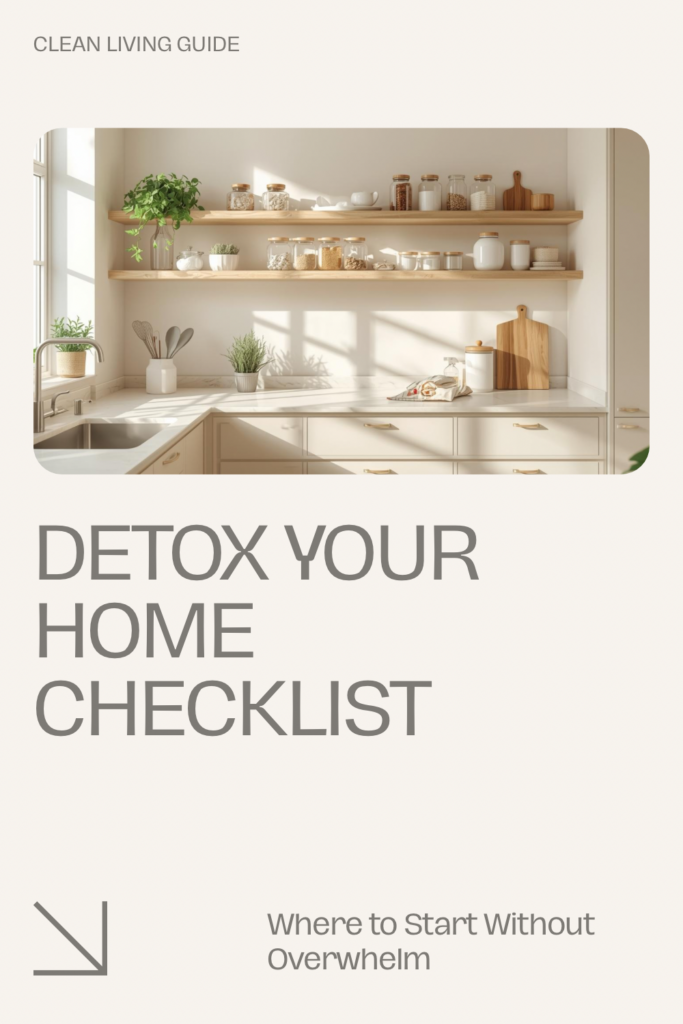
Detox Your Home Checklist
This is a leverage project, not a perfection project. Start with the highest-contact categories (air + skin + food contact). Go slowly. Stop when life starts getting spicy.
Kitchen equipment swaps
Laundry + fabric care
If you’re in a high-reactivity season, the goal is stability first. You can always “optimize” later.
1) Air + fragrance (highest leverage)
Air exposure is sneaky because it feels “normal.” But if you’re dealing with headaches, asthma, autoimmune flares, skin sensitivity, or just that vague “my body is mad” feeling, fragrance is often the first domino.
- Remove plug-ins, air fresheners, scented candles, and fragrance sprays.
- Be picky with “natural fragrance.” It’s still fragrance.
- Open windows when possible. The OG air purifier.
2) Laundry + fabric contact (the daily exposure people forget)
Your clothes and bedding touch your skin for 8–16 hours a day. Laundry is a bigger lever than most people realize because it combines: heat + friction + residue + prolonged contact.
What matters most
- Unscented detergent (and skip optical brighteners).
- Skip dryer sheets (they leave residue and fragrance behind).
- Wash bags for merino/underwear/delicates.
- Cold wash + gentle cycles when possible.
My real-life approach: I rotate simple, gentle options (unscented powder/liquid + plain liquid Castile soap for certain loads). The brand matters less than the system: unscented + gentle + no residue.
3) Kitchen swaps: nonstick, plastics, silicone, food contact
Kitchen swaps matter because heat changes chemistry. The goal is simple: reduce what leaches into food—especially with hot oils, acidic foods, and high heat.
Start here (highest impact)
- Retire scratched nonstick. If it’s peeling, flaking, or “mysteriously sticky,” it’s done.
- Stop heating food in plastic. Especially in microwaves, dishwashers, or hot cars.
- Swap your “hot tools” first: spatulas, turners, cooking spoons, baking mats, and anything that touches heat.
What to swap to (simple + durable)
- Cast iron stovetop workhorse
- Stainless steel sauté + pots
- Carbon steel lighter “pan” option
- Glass storage + baking
- Porcelain / ceramic baking (choose reputable brands)
- Wood spoons + boards
- Clean enamel / enameled cast iron simmering + soups
About silicone (a helpful nuance)
Silicone can be a reasonable tool in some situations, but I treat it with discernment—especially with heat.
- Prefer uncolored/neutral silicone for anything that touches heat, because dyes and additives vary.
- Use silicone more for cold/room-temp tasks and rely on stainless/glass/cast iron for high heat.
- If it holds smells, feels tacky, or degrades, retire it.
Simple rule: If it’s hot, oily, or acidic—choose metal, glass, cast iron, or enamel.
4) Personal care: the “close-to-the-body” wins
You don’t need a 47-step routine. You need a few basics that don’t irritate your skin or quietly add to chemical load.
- Hand soap + lotion (constant exposure)
- Deodorant (daily, occluded skin)
- Hair products if you’re reactive (scalp is absorbent)
- Fragrance (if you do nothing else, remove this)
5) When disinfection actually matters
Most daily cleaning is about mechanical removal—lifting residue and debris so it doesn’t accumulate. True disinfection is for specific situations (illness, bodily fluids, higher-risk environments).
When I want stronger sanitation without the “my lungs hate me” effect of conventional disinfectants, I use hypochlorous acid (HOCl) systems.
Easy, vetted swaps (if you want a shortcut)
If you’d rather not research every product from scratch, these are the places I send clients and readers for lower-tox, ingredient-vetted options I actually trust and use.
- ShopMy – clothing, home, kitchen, and personal care swaps I’ve personally tested
- Fullscript – practitioner-grade supplements and tools I use with clients
Use what’s helpful. Ignore the rest. This is not an all-or-nothing project.
Related reading + what’s coming
- Why I Changed the Way I Clean (and What I Use Now)
- Kitchen Equipment Swaps (deep dive: cookware, storage, tools, and what matters most)
- Laundry Detergent & Fabric Care (gentle detergents + merino-safe laundry)
- Detox Your Home: The “Do This First If…” Guide (sensitive skin, asthma, mold history, etc.)
Disclosure: This post may contain affiliate links. Using them doesn’t change your price and helps support my work.